
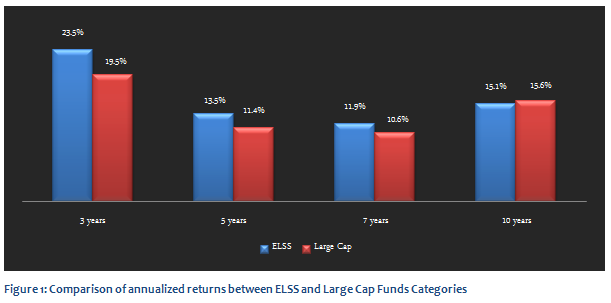
One of the oldest tax saving mutual funds in India, SBI Magnum Taxgain Scheme 93, has continued to deliver strong returns even in the recent past. SBI Magnum Taxgain Scheme delivered over 20% returns in the last 12 months and over 25% trailing annualized returns in the last 3 years. Equity Linked Saving Schemes (ELSS) is one of the most popular investments allowed under Section 80C, since the investors can avail double benefits of capital appreciation and tax savings. Over various periods ELSS has generated slightly better returns than Diversified Equity Funds though over the long term the performance differential levels out. The lock-in period of three years in ELSS is advantageous from a fund management perspective, since the fund managers are free from redemption pressures during the lock-in period and therefore are able to hold the stocks in their portfolio for a longer period of time, to generate superior returns. See the chart below, for the comparison of annualized returns over three, five, seven and ten year periods, between ELSS and the large cap funds categories (NAVs as on 10.6.2015).
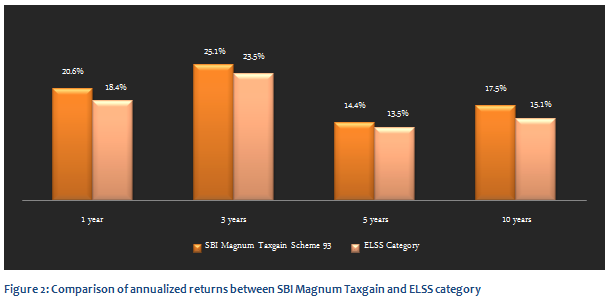
SBI Magnum Taxgain, which completed 22 years this April, has outperformed the ELSS funds category across several time periods. See the chart below, for the comparison of annualized returns over one, three, five and ten year periods, between SBI Magnum Taxgain Scheme (Growth) and the ELSS Category (NAVs as on June 10)
SBI Magnum Taxgain Scheme 93 – Fund Overview
This fund is suitable for investors looking for tax planning investment options under Section 80C with the expectation of long term capital appreciation. However, since this is essentially an equity oriented mutual fund, it is subject to market risk and volatility, compared to other tax saving instruments like PPF, NSC etc. However, equities as an asset class generate superior returns over the long term and serves as an effective hedge against inflation. As such, the fund is suitable for investors planning for long term financial objectives like retirement planning, children's education, marriage etc.
The SBI Magnum Taxgain Scheme was launched in 1993. The fund has an AUM base of nearly Rs 5,000 crores with an expense ratio of 2.21%. The fund manager of this scheme is Jayesh Shroff since 2007.
Portfolio Construction
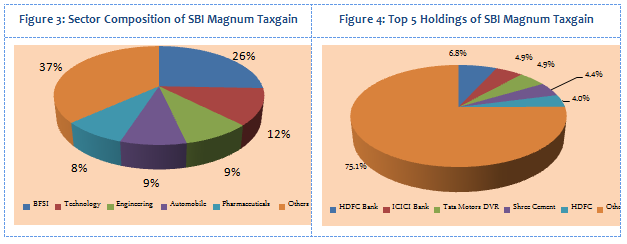
The fund manager has a focused portfolio for SBI Magnum Taxgain Scheme with a bias towards large cap companies. Large cap companies account for 62% of the portfolio, while mid and small companies account for 38% of the portfolio (as on end April 2015). From a sector perspective, the portfolio has a bias for cyclical sectors like Banking and Financial Services (BFSI), Engineering and Automobiles, but it also has substantial allocations to defensive sectors like Technology and Pharmaceuticals. This portfolio construction enables the fund manager to get good returns across different market conditions. In terms of company concentration, the portfolio is very well diversified with its top 5 holdings, HDFC Bank, ICICI Bank, Tata Motors DVR, Shree Cement and HDFC accounting for only 25% of the total portfolio value. Even the top 10 holdings account for only about 43% of the portfolio value.
Risk & Return
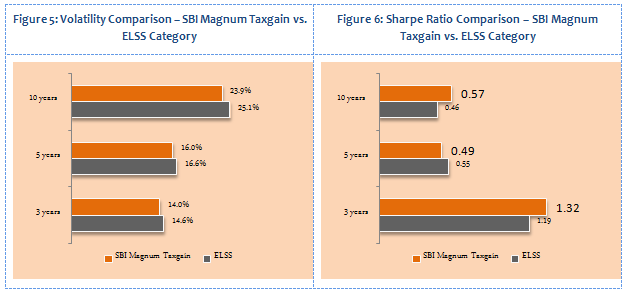
From a risk perspective, the volatility of the fund is lower than the ELSS category. The annualized standard deviations of monthly returns of SBI Magnum Taxgain Scheme for three to ten year periods are in the range of 14% and 24% respectively. While the volatility of the fund is lower than its peers, the fund has outperformed the ELSS category. This implies strong risk adjusted returns for the investors. As a result the SBI Magnum Taxgain Scheme has delivered superior Sharpe Ratios, a measure of risk adjusted returns, relative to ELSS Funds as a category, across various time periods. See charts below for comparison of volatilities and Sharpe ratios between SBI Magnum Taxgain Scheme 93 and ELSS funds category
Comparison with Peer Set
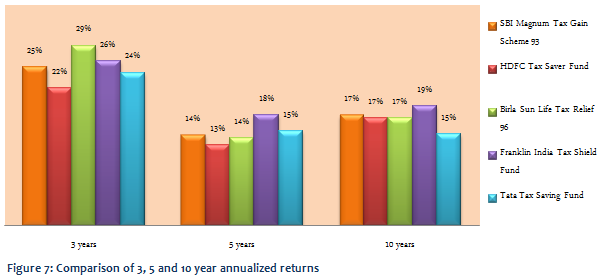
A comparison of annualized returns of SBI Magnum Taxgain Scheme versus its peer set over various time periods shows why this fund is considered a consistently strong performer among its peers. All these ELSS schemes have completed at least 15 years and are evenly matched in terms of performance. However, SBI Magnum Taxgain Scheme and Franklin India Taxshield hold a slight edge over the others in terms of long term performance. See chart below for comparison of annualized returns over three, five year and 10 year periods. NAVs as on 10.6.2015.
Dividend Payout Track Record
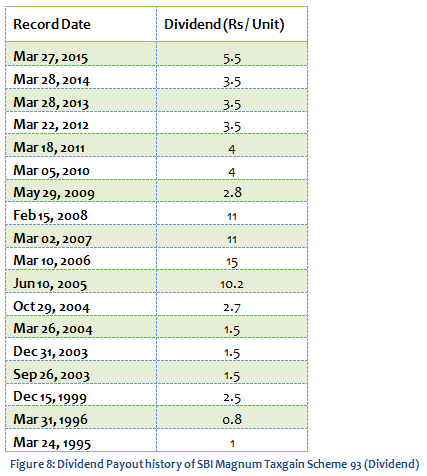
SBI Magnum Taxgain Scheme has an excellent dividend payout track record. Over the last 20 years, the company has paid dividends in 15 years. In fact the fund has not missed paying dividends on any year after 2002. This demonstrates the good track record of the fund even under difficult market conditions.
SIP and Lump Sum Returns
The chart below shows returns of र 3,000 monthly SIP in the SBI Magnum Taxgain Scheme (Growth Option), over the last 10 years. The SIP date has been assumed to be the first working day of the month.
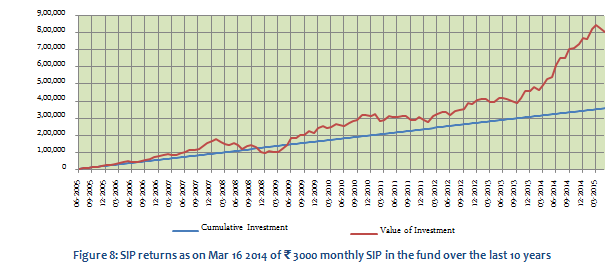
The chart above shows that, a monthly SIP of र 3000 started 10 years back have grown to nearly र 8 lacs, while the investor would have invested in total only र 3.6 lacs. This would imply an internal rate of return of more than 15%, which is much higher than returns of some other tax saving investments (e.g. PPF) in the same period. If the investor started his SIP 20 years back, his or her corpus would have grown to over र 92 lacs, with an investment of only र 7.2 lacs. This shows that how SIPs can create wealth through the power of compounding.
If the investor had invested र 1 lac in the NFO, his or her investment would have grown to nearly र 40 lacs, assuming that the dividends have been reinvested.
Conclusion
The SBI Magnum Taxgain Scheme 93 has delivered over 20 years of strong and consistent performance. The fund has established itself as a top performer tax saving scheme with great track record of investment returns and dividends. Investors should ensure that the objectives of the funds are aligned with their individual risk profiles and time horizons. They should consult with their financial advisors if SBI Magnum Taxgain Scheme is suitable for their investment portfolio.
Top 10 Tax Saving Mutual Funds to invest in India for 2016
Best 10 ELSS Mutual Funds in india for 2016
1. BNP Paribas Long Term Equity Fund
2. Axis Tax Saver Fund
3. Franklin India TaxShield
4. ICICI Prudential Long Term Equity Fund
5. IDFC Tax Advantage (ELSS) Fund
6. Birla Sun Life Tax Relief 96
7. DSP BlackRock Tax Saver Fund
8. Reliance Tax Saver (ELSS) Fund
9. Religare Tax Plan
10. Birla Sun Life Tax Plan
Invest in Best Performing 2016 Tax Saver Mutual Funds Online
For further information contact Prajna Capital on 94 8300 8300 by leaving a missed call
---------------------------------------------
Leave your comment with mail ID and we will answer them
OR
You can write to us at
PrajnaCapital [at] Gmail [dot] Com
OR
Leave a missed Call on 94 8300 8300
-----------------------------------------------
