
Franklin India Taxshield Fund - A Tax Saver Funds

Franklin India Taxshield Fund Invest Online
 
Equity Linked Savings Scheme article in Advisorkhoj - Franklin India Taxshield Fund: One of the biggest wealth creators among ELSS funds
Picture courtesy - GraphicStock

With Equity Linked Savings Schemes investors can not only save taxes, but by investing in the over the long term can create substantial wealth. Franklin India Taxshield is one of the greatest wealth creators among ELSS funds. 1 lac invested in the Franklin India Taxshield Fund (growth Option) NFO in 1999 would have grown to over 43 lacs by April 2, 2015. This fund launched in April 1999, has beaten the returns of ELSS category and generated significant alphas. See the chart below, for the comparison of annualized returns over one, three, five and ten year periods, between Franklin India Taxshield fund (Growth) and the ELSS funds category average (NAVs as on April 8).
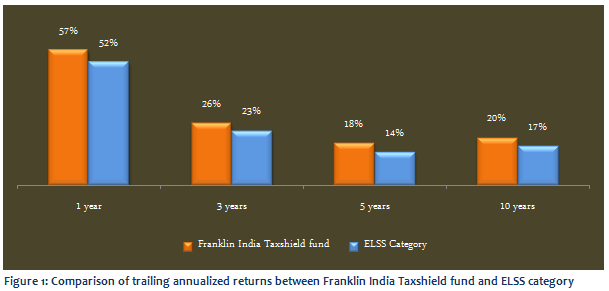
Equity Linked Saving Schemes - Comparison of trailing annualized returns between Franklin India Taxshield fund and the ELSS funds category

The fund has been ranked a Good performer (Rank 2) by CRISIL and Morningstar has assigned a 5 star rating for this fund.

Fund Overview

This fund from the Franklin Templeton stable is suitable for investors looking for tax planning investment options under Section 80C with the expectation of long term capital appreciation. However, since this is essentially a diversified equity fund, it is subject to market risk and volatility as compared to other fixed income tax saving instruments like PPF, NSC etc. However, equities as an asset class generate superior returns over the long term and as such the fund is suitable for investors planning for long term financial objectives like retirement planning, children's education, etc. The fund has an AUM base of over Rs 1,670 crores, with an expense ratio of 2.42%. The fund manager of this scheme is Anand Radhakrishnan and Anil Prabhudas.

Portfolio Construction

While the fund portfolio has a large cap bias, the fund managers are focused on investing in good growth stocks. Large cap stocks form around 58% of the fund's portfolio, while midcap and small cap stocks comprise the rest. The fund managers employ a bottom-up approach to identify stocks with good appreciation potential and attractive valuations. From a sector perspective, the portfolio has a bias for cyclical sectors like BFSI, Engineering, Automobiles and Auto Ancillaries, but it also has substantial allocations to defensive sectors like IT and Pharmaceuticals. This portfolio construction enables the fund manager to get good returns across different market conditions. In terms of company concentration, the portfolio is very well diversified with its top 5 holdings, HDFC Bank, Infosys, ICICI Bank, Indusind Bank and Yes Bank accounting for only 26% of the total portfolio value. The top 10 stocks account for only 40% of the portfolio holdings.
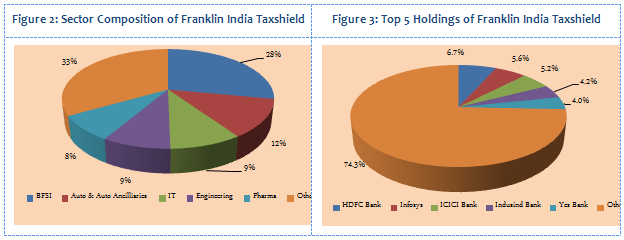
Equity Linked Saving Schemes - Sector Composition and Top 5 Holdings of Franklin India Taxshield

Performance comparison with Peer Set

A comparison of annualized returns of Franklin India Taxshield Fund versus its peer set over various time periods shows why this fund is considered one of the top performers among ELSS funds. In terms of trailing annualized returns, the fund has beaten most of its peers across most time periods. See chart below for comparison of annualized returns over one, two and three year periods. NAVs as on April 8 2014.
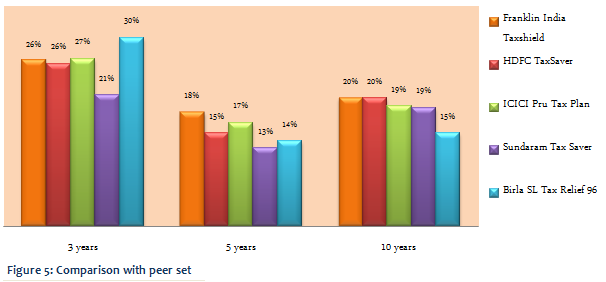
Equity Linked Saving Schemes - Comparison with peer set

Risk & Return

Even though the Franklin India Taxshield Fund has outperformed the ELSS category in terms of returns, from a risk perspective, the volatility of the fund is lower than that of the ELSS category. The annualized standard deviation of monthly returns of Franklin India Taxshield Fund over the last three years is 13.5% compared to 15% for the ELSS category. The Sharpe Ratio of Franklin India Taxshield fund is higher than that of the ELSS category, implying superior risk adjusted return from this fund relative to other ELSS funds. See charts below for comparison of volatilities and Sharpe ratios between Franklin India Taxshield Fund and ELSS funds category.
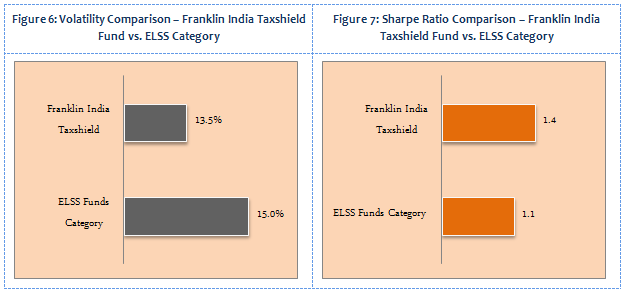
Equity Linked Saving Schemes - Volatility Comparison and Sharp Ratio Comparison - Franklin India Taxshield Fund vs. ELSS Caegory

Franklin India Taxshield Fund (Dividend Option) has an excellent dividend payout track record. The fund has paid dividend on a fairly regular basis over the last 10 to 15 years. The table shows the dividend history of the Franklin India Taxshield Fund (Dividend Option) over the last 15 years.
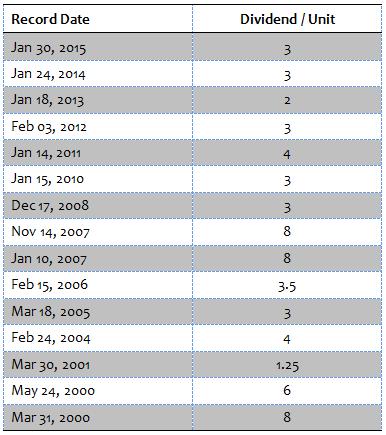
Equity Linked Saving Schemes - Dividend history of the Franklin India Taxshield Fund (Dividend Option) over the last 15 years

1 lac lump sum investment in the Franklin India Taxshield Fund (growth option) ten years back would have grown to value of nearly 6.5 lacs as on April 8 2015. The chart below shows the growth of 1 lac investment in the Franklin India Taxshield Fund (growth option). This implies a compounded annual return of 21%.
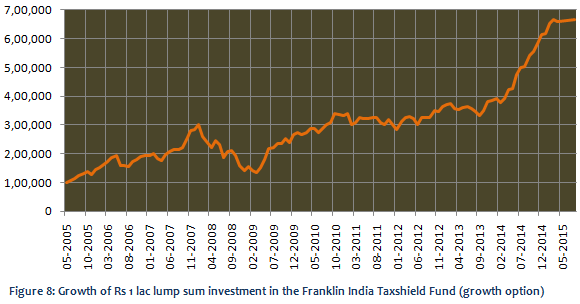
Equity Linked Saving Schemes - Growth of Rs. 1 lac investment in the Franklin India Taxshield Fund (growth option)

The chart below shows the returns of 3000 monthly SIP in the Franklin India Taxshield Fund (growth option) over the last 10 years. The SIP date has been assumed to first working day of the month. The chart below shows the SIP returns of the fund. NAVs as on April 8 2015.
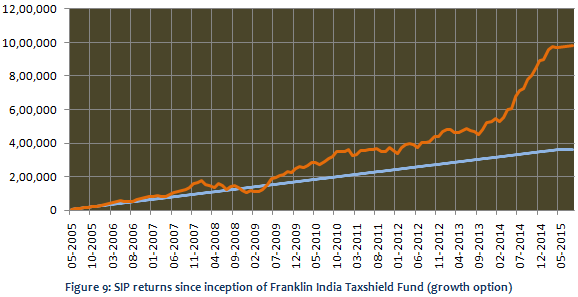
Equity Linked Saving Schemes - SIP returns since inception of Franklin India Taxshield Fund (growth option)

The chart above shows that a monthly SIP of 3000 in Franklin India Taxshield Fund (growth option) started 10 years back, would have grown to over 9.8 lacs by April 1 2015, while the investor would have invested only 3.6 lacs. The SIP return (as measured by XIRR) of the fund over the last years is 19%.

Conclusion

Thus we can see that Franklin India Taxshield Fund has not only helped investors save taxes but has also created substantial wealth for them. Investors planning for tax saving investments can consider buying the scheme through the systematic investment plan (SIP) or lump sum route with a long time horizon. Investors looking for tax free dividends can invest in the dividend option of the scheme. Investors should consult with their financial advisors to ensure that the investment objectives of the Franklin India Taxshield Fund are aligned with their risk profile and financial goals.

-----------------------------------------------
Invest Rs 1,50,000 and Save Tax under Section 80C. Get Great Returns by Investing in Best Performing ELSS Mutual Funds

Top 10 Tax Saving Mutual Funds to invest in India for 2016

Best 10 ELSS Mutual Funds in india for 2016

1. BNP Paribas Long Term Equity Fund

2. Axis Tax Saver Fund

3. Franklin India TaxShield

4. ICICI Prudential Long Term Equity Fund

5. IDFC Tax Advantage (ELSS) Fund

6. Birla Sun Life Tax Relief 96

7. DSP BlackRock Tax Saver Fund

8. Reliance Tax Saver (ELSS) Fund

9. Religare Tax Plan

10. Birla Sun Life Tax Plan

Invest in Best Performing 2016 Tax Saver Mutual Funds Online

Invest Online

Download Application Forms

For further information contact Prajna Capital on 94 8300 8300 by leaving a missed call

---------------------------------------------

Leave your comment with mail ID and we will answer them

OR

You can write to us at

PrajnaCapital [at] Gmail [dot] Com

OR

Leave a missed Call on 94 8300 8300

-----------------------------------------------

Popular posts from this blog

What are the factors affect the changes in Interest Rate of Fixed Deposits?

  What are the factors affect the changes in rate of Fixed Deposits? Fixed Deposits are now considered to be a very old fashioned method of saving, but still attract many investors since they have guaranteed returns at the end of the tenure of the investment at a decent interest rate. There are various factors that affect the rates of interest for a Fixed Deposit. Policies of the Reserve Bank of India   - The several norms and restrictions posed by the Reserve Bank of India , in order to gain optimum control over credit and inflow and outflow of fund throughout the country. The repo rate changes, cash reserve ration tends to change and these changes affect the banking products like Fixed Deposits, loans etc. Recession   - When unemployment in a country crosses the benchmark set Recession hits, and slowly the country faces an economic slow movement, affecting the purchasing power of the people in the country, forcing the Reserve Bank of India to release more funds in the financial marke...

Capital Protection Oriented Funds

Download Tax Saving Mutual Fund Application Forms Invest In Tax Saving Mutual Funds Online Buy Gold Mutual Funds Leave a missed Call on 94 8300 8300   Capital Protection Oriented Funds   Erosion of capital is one of the key concerns for investors wanting to invest in equity mutual funds. To address this concern, asset management companies have launched Capital Protection Oriented Funds (CPOFs). What are CPOFs? CPOFs are generally three to five-year, closed-ended funds where 70-80% of the portfolio is invested in fixed income securities, which mature on or before the scheme's tenure. The investment in fixed income securities grows to 100% at the end of the tenure, providing the investor with capital protection. The remaining portion (20-30%) is used to take exposure to equity, which provides the upside. Exposure to equities is either by directly buying equity stocks (plain vanilla CPOFs) or by b...

Understanding Your Cibil Credit Information Report

   WE ARE all familiar with the anxiety and uncertainty that we feel when applying for a loan. After all, it's the lender who decides whether we can own our dream home, our first car, or whether our children can pursue higher education. In a nutshell, a better life depends on the lender's decisions.    While other factors do play a part in the lender's decision, the Cibil Credit Information Report ( CIR ) plays a crucial role in a lender's decision to approve a loan application.    Previously, lenders would treat all loan seekers equally. Each applicant, if approved by the lender's internal credit policy, would be charged at the same interest rate for a particular loan size and purpose. The lenders would charge a higher interest rate to all the borrowers, in order to compensate for the possible default of a small portion of the loan disbursed. In other words, it's like a professor (the lender) punishing an entire class (borrowers) for the mischief played b...

Good Loan

Why Is It A Good Loan?: Loans against gold are cheaper and better than personal loans as the former are available at lower interest rates. In contrast, the interest rates on personal loans are not standardised and can vary from bank to bank. Also, a personal loan depends on a host of factors including, the borrower's salary, profession and the purpose for which the loan is being taken.      For instance, the interest rate on a personal loan of 5 lakh falls in a wide range of 15-30%. But loans against gold are available for as low as 11%. Secured borrowing such as a loan against gold, investments or property is cheaper because it is backed by some assets, which command a good value at any point of time. If the borrower defaults on the loan, the banks can liquidate the assets to settle the loan account.    Being a secured loan, the risk of default and credit losses is significantly lower in this loan compared to other forms of loan for personal use. Given the lower risk, gold loa...

Mutual Fund Review: ING Dividend Yield

  ING Dividend Yield's small assets enable the fund manager to churn in impressive returns… Strategy The aim of the fund is to invest in stocks which offer a high dividend yield. This fund deploys a value based strategy which aims to gain from investing in fundamentally strong and free cash flow generating businesses. The scheme focuses not only on growth but also on the cash generated by the business, which mostly leads to stable returns even in volatile markets. This fund has a low volatility because of its investment in high yielding stocks. The scheme tries to include stocks that yield dividend above the dividend yield of the Nifty and stocks with liquidity, which throws up a universe of 150 stocks.   Our View Launched in October 2005, this fund invests at least 65 per cent of its assets in high dividend yield stocks. The fund has consistently maintained a mix of stocks across varying market capitalisation, with a higher tilt to mid caps compared to small caps. Howev...
Related Posts Plugin for WordPress, Blogger...
Invest in Tax Saving Mutual Funds Download Any Applications
Transact Mutual Funds Online Invest Online
Buy Gold Mutual Funds Invest Now