
DSP BlackRock Tax Saver Fund - A ELSS Fund for 2016


DSP BlackRock Tax Saver Fund Invest Online

 
Equity Linked Savings Scheme article in Advisorkhoj - DSP BlackRock Tax Saver Fund: Nearly 2X returns in last 3 years makes it a top ELSS fund
 

ELSS funds offer triple benefits of tax savings, capital appreciation and tax free returns to the investor. The DSP BlackRock Tax Saver fund, one of the top ELSS funds, has outperformed the tax saving funds category by delivering two times returns in the last three years. The fund has consistently given superior returns relative to the ELSS funds category and the broader market, over the different time periods. The chart below shows the annualized trailing returns of the DSP BlackRock Tax Saver fund growth option, regular plan, over the last 1, 3 and 5 year time periods, compared to the ELSS funds category and the CNX 500 index. NAVs as on June September 19 2014.
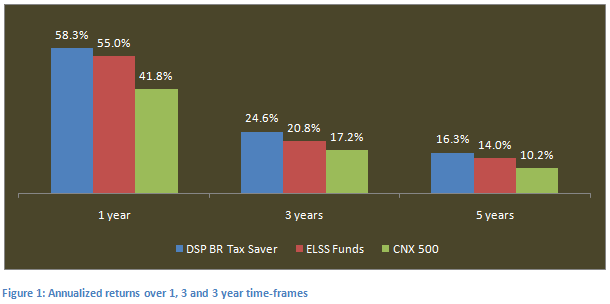
Equity Linked Saving Schemes - Annualized trailing returns of the DSP BlackRock Tax Saver fund growth option, regular plan, over the last 1, 3 and 5 year time periods, compared to the ELSS funds category and the CNX 500 index

Fund Overview

The DSP BlackRock Tax Saver Fund was launched in November 2006 and has performed very well relative to the market since its inception. The fund has 814 crores of assets under management. The expense ratio of the fund is 2.66%. The manager of this fund is Apoorva Shah. Apoorva has delivered good returns for all the funds that he is managing for DSP BlackRock. The minimum investment for this fund is 5000. Morningstar has a 4 star rating for this fund. The fund is suitable for investors planning to make 80C investments for long term investment objectives, like retirement planning, children's education etc. The fund is open for both growth and dividend options.

Portfolio Composition

The fund has a large cap, growth oriented focus. The fund manager has a bottoms-up portfolio construction approach. The fund manager tries to identify stocks with high growth potential for this portfolio. He also invests in stocks that are trading at attractive valuations. The portfolio is overweight on cyclical sectors like BFSI, Oil & Gas, Automobile & Auto Ancillaries etc. To balance its exposure to cyclical, the portfolio also has allocations to defensive sectors, with IT and Pharmaceuticals comprising nearly 15% of the portfolio holdings, as on May 31 2014. With cyclical sectors poised to do well with the revival in economic growth and capex cycle, the DSP BlackRock Tax Saver fund has the potential to deliver good returns over the short to medium term. The portfolio is very well diversified in terms of company concentration. The top 5 companies in the fund portfolio, ICICI Bank, Infosys, TCS, Larsen & Toubro, and SBI account for only 20% of the portfolio value. Even the top 10 companies in the fund's portfolio account for less than 34% of the portfolio holdings.
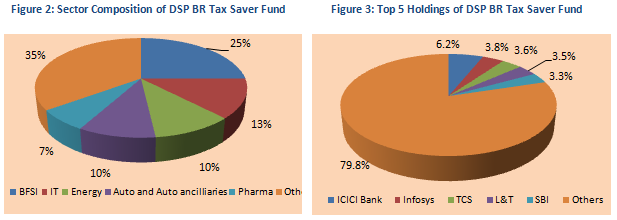
Equity Linked Saving Schemes - Sector Composition and Top 5 Holdings of DSPBR Tax Saver Fund

Comparison with Peer Sets

DSP BlackRock Tax Saver fund is one the top performing ELSS funds. The chart below shows the comparison of 1 year, 3 years and 5 years annualized returns of the DSP BlackRock Tax Saver with other top performing ELSS funds.
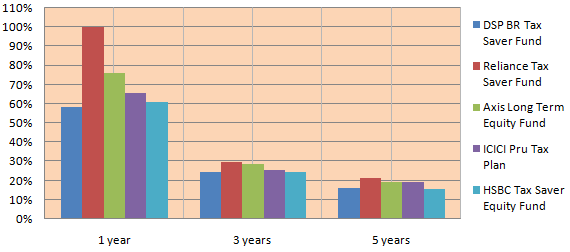
Equity Linked Saving Schemes - Comparison of 1 year, 3 years and 5 years annualized returns of the DSP BlackRock Tax Saver with other top performing ELSS funds

Risk and Return

The DSP BlackRock Tax Saver fund has consistently outperformed the ELSS funds category and the CNX 500 over the last 3 years. The fund gave a trailing return of over 58% and 24% in the last one and three years respectively. In terms of risk measures, the annualized standard deviation of monthly returns of the DSP BlackRock Tax Saver fund is in line with the ELSS funds category. However, on a risk adjusted returns basis, as measured by Sharpe Ratio, the DSP BlackRock Tax Saver fund has outperformed the ELSS funds category. Sharpe ratio is defined as the ratio of excess return (i.e. difference of return of the fund and risk free return from Government securities) and annualized standard deviation of returns. Higher the Sharpe ratio better is the risk adjusted performance of the fund. See charts below for comparison of volatilities and Sharpe ratios of the DSP BlackRock Tax Saver and the ELSS Funds Category
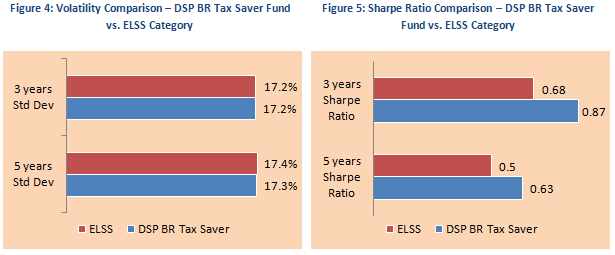
Equity Linked Saving Schemes - Volatility Comparison and Sharp Ratio Comparison - DSPBR Tax Saver Fund vs. ELSS Category

1 lac lump sum investment in the fund NFO (growth option) would be at a value of 2.93 lacs as on Sep 19 2014. The chart below shows the growth of 1 lac investment in the DSP BlackRock Tax saver fund (growth option).
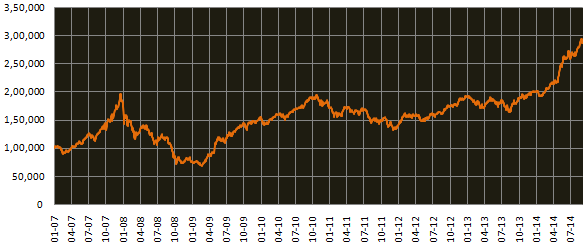
Equity Linked Saving Schemes - Growth of 1 lac investment in the DSP BlackRock Tax saver fund (growth option)

The chart below shows the returns since inception of 3000 monthly SIP in the DSP BlackRock Tax Saver fund (growth option). The SIP date has been assumed to first working day of the month. The chart below shows the SIP returns of the fund.
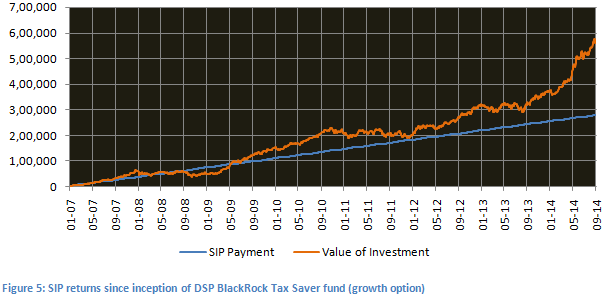
Equity Linked Saving Schemes - SIP returns since inception of DSP BlackRock Tax saver fund (growth option)

The chart above shows that a monthly SIP of 3000 started at inception of the DSP BlackRock Tax saver fund (growth option) would have grown to over 5.7 lacs by Sep 19 2014, while the investor would have invested in total only about 2.8 lacs. The SIP return (XIRR) is over 18% since inception.

Conclusion

The DSP BlackRock tax saver fund has delivered over 7 years of strong performance. This fund is suitable for 80C investors with a long time horizon. Investors can consider investing in the scheme through the systematic investment plan (SIP) or lump sum route. Investors should consult with Prajna Capital, if DSP BlackRock Tax Saver fund is suitable for their tax planning needs.

-----------------------------------------------
Invest Rs 1,50,000 and Save Tax under Section 80C. Get Great Returns by Investing in Best Performing ELSS Mutual Funds

Top 10 Tax Saving Mutual Funds to invest in India for 2016

Best 10 ELSS Mutual Funds in india for 2016

1. BNP Paribas Long Term Equity Fund

2. Axis Tax Saver Fund

3. Franklin India TaxShield

4. ICICI Prudential Long Term Equity Fund

5. IDFC Tax Advantage (ELSS) Fund

6. Birla Sun Life Tax Relief 96

7. DSP BlackRock Tax Saver Fund

8. Reliance Tax Saver (ELSS) Fund

9. Religare Tax Plan

10. Birla Sun Life Tax Plan

Invest in Best Performing 2016 Tax Saver Mutual Funds Online

Invest Online

Download Application Forms

For further information contact Prajna Capital on 94 8300 8300 by leaving a missed call

---------------------------------------------

Leave your comment with mail ID and we will answer them

OR

You can write to us at

PrajnaCapital [at] Gmail [dot] Com

OR

Leave a missed Call on 94 8300 8300

-----------------------------------------------

Popular posts from this blog

Mutual Fund MIPs can give better returns than Post Office MIS

Post Office MIS vs  Mutual Fund MIPs   Post office Monthly Income Scheme has for long been a favourite with investors who want regular monthly income from their investments. They offer risk free 8.5% returns and are especially preferred by conservative investors, like retirees who need regular monthly income from their investments. However, top performing mutual fund monthly income plans (MIPs) have beaten Post Office Monthly Income Scheme (MIS), in terms of annualized returns over the last 5 years, by investing a small part of the corpus in equities which can give higher returns than fixed income investments. The value proposition of the mutual fund aggressive MIPs is that, the interest from debt investment is supplemented by an additional boost to equity returns. Please see the chart below for five year annualized returns from Post office MIS and top performing mutual fund MIPs, monthly d...

All about "Derivatives"

What are derivatives? Derivatives are financial instruments, which as the name suggests, derive their value from another asset — called the underlying. What are the typical underlying assets? Any asset, whose price is dynamic, probably has a derivative contract today. The most popular ones being stocks, indices, precious metals, commodities, agro products, currencies, etc. Why were they invented? In an increasingly dynamic world, prices of virtually all assets keep changing, thereby exposing participants to price risks. Hence, derivatives were invented to negate these price fluctuations. For example, a wheat farmer expects to sell his crop at the current price of Rs 10/kg and make profits of Rs 2/kg. But, by the time his crop is ready, the price of wheat may have gone down to Rs 5/kg, making him sell his crop at a loss of Rs 3/kg. In order to avoid this, he may enter into a forward contract, agreeing to sell wheat at Rs 10/ kg, right at the outset. So, even if the price of wheat falls ...

Benefits Of Repo Rate & CRR Rate Cut On Consumers

  How Reduction In Repo Rate & CRR Affects Customers Finally  RBI announced slashing of repo rate by 25 basis points (bps ) and cash reserve ratio (CRR) by 25 bps which industry experts believe will fuel the economic growth to some extent. Although experts were expecting higher rate cut this year. This lowering of the rate cuts has taken place for the first time in nine months. Now let's see how reducing the repo rate (defined in economic term as the rate at which RBI lends money to the banks) relates to the following individuals and sectors: Banking:   Lowering of repo rate directly reduces borrowing costs of a bank. Banks in turn reduces interest rates on different types of loans such as home, auto, business etc. Similarly trimming down of CRR allows banks to unlock money for lending to the customers i.e. with 0.25 rate cut banks are estimated to lend more than INR. 17 Crores. Consumers:   Lower repo rate does not necessarily benefit existing loan borrowers but new loan se...

NRI Corner: The process of remittances abroad

The process of remittances abroad, and back, is cumbersome. Here’s how you can wade through without hassles Approach The Right Place Outward remittances or the process of sending money abroad is governed by many regulations. In India, outward remittances are made mainly through banks. At the outset, you need to remember that you just cannot trust any individual or a financial firm with the responsibility of sending your money. Experts recommend that you should always try to choose a bank with an international footprint, which will make your job easier. Choose Mode Of Transfer The next step is to choose the mode of transfer. One option is to get a Foreign Currency Demand Draft ( FCDD ). This draft will be denominated in foreign currency and should be drawn in favour of the recipient/ beneficiary. The beneficiary does not necessarily need to have an account with the same bank. The other option is to send money via wire transfer. Do not be puzzled if the bank official uses the word SWIFT ...

Zero Coupon Bonds or discount bond or deep discount bond

A ZERO-COUPON bond (also called a discount bond or deep discount bond ) is a bond bought at a price lower than its face value with the face value repaid at the time of maturity.   There is no coupon or interim payments, hence the term zero-coupon bond. Investors earn return from the compounded interest all paid at maturity plus the difference between the discounted price of the bond and its par (or redemption) value. In contrast, an investor who has a regular bond receives income from coupon payments, which are usually made semi-annually. The investor also receives the principal or face value of the investment when the bond matures. Zero-coupon bonds may be long or short-term investments.   Long term zero coupon maturity dates typically start at 10 years. The bonds can be held until maturity or sold on secondary bond markets.
Related Posts Plugin for WordPress, Blogger...
Invest in Tax Saving Mutual Funds Download Any Applications
Transact Mutual Funds Online Invest Online
Buy Gold Mutual Funds Invest Now