
ICICI Prudential Tax Plan is the best equity linked savings scheme in the last five years, on the basis of annualized returns. Equity Linked Saving Schemes (ELSS) is one of the most popular investments allowed under Section 80C, since the investors can avail double benefits of capital appreciation and tax savings. An ELSS is a diversified equity scheme with a lock in period of three years from the date of the investment. If you invest in an ELSS through a systematic investment plan (SIP), each investment will be locked in for 3 years from their respective investment dates. From tax purposes, both long term capital gains and dividends from ELSS are tax free.
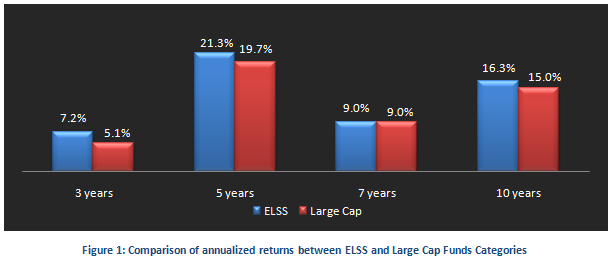
Over various periods ELSS has generated slightly better returns than Large Cap Funds as a category. The lock-in period of three years in ELSS is advantageous from a fund management perspective, since the fund managers are free from redemption pressures during the lock-in period and therefore are able to hold the stocks in their portfolio for a longer period of time, to generate superior returns. See the chart below, for the comparison of annualized returns over three, five, seven and ten year periods, between ELSS and the large cap funds categories (NAVs as on Mar 16)
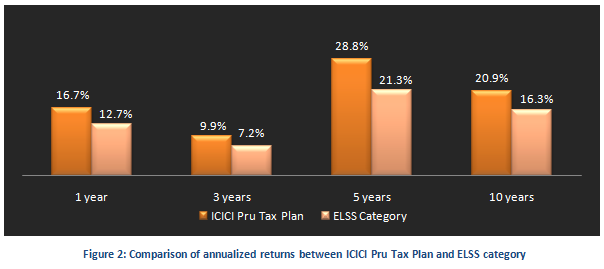
ICICI Prudential Tax Plan, which complete 15 years this August, is clearly a top performer in this category across several time periods. See the chart below, for the comparison of annualized returns over one, three, five and ten year periods, between ICICI Prudential Tax Plan (Growth) and the ELSS Category (NAVs as on Mar 16)
ICICI Prudential Tax Plan – Fund Overview
This fund is suitable for investors looking for tax planning investment options under 80C with the expectation of long term capital appreciation. However, since this is essentially an equity oriented mutual fund, it is subject to market risk and volatility, compared to other tax saving instruments like PPF, NSC etc. However, equities as an asset class generate superior returns over the long term and serves as an effective hedge against inflation. As such, the fund is suitable for investors planning for long term financial objectives like retirement planning, children's education, marriage etc. The ICICI Prudential Tax Plan was launched in 1999. The scheme is open both for growth and dividend plans. The fund has an AUM base of over Rs 1,500 crores, with an expense ratio of 2.24%. ICICI Prudential is one of the largest asset management companies in the country. The fund manager of this scheme is Chintan Haria since 2013. Previously the fund was managed by ICICI Prudential CIO Sankaran Naren, under whose watch the fund had delivered excellent returns. Chintan is following the investment approach and process of Sankaran. In the brief time that Chintan has been the fund manager of this scheme, the fund has continued to deliver strong result. The current NAV (as on Mar 16 2014) is 178.1 for the growth plan and 18.2 for the dividend plan.
Portfolio Construction
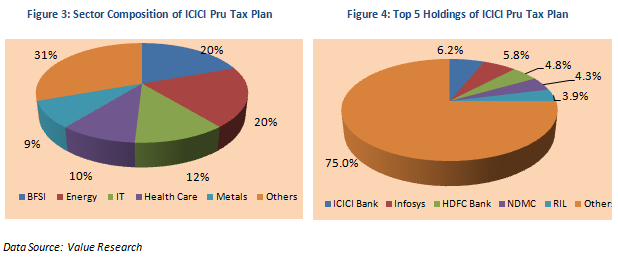
The fund manager has a multi cap and high growth potential focus for his portfolio. The fund manager identifies stocks and sectors with attractive valuations. From a sector perspective, the portfolio has a bias for cyclical sectors like BFSI, Energy and Metals, but it also has substantial allocations to defensive sectors like IT and Healthcare. This portfolio construction enables the fund manager to get good returns across different market conditions. In terms of company concentration, the portfolio is very well diversified with its top 5 holdings, ICICI Bank, Infosys, HDFC Bank, NDMC and Reliance Industries accounting for only 25% of the total portfolio value.
Risk & Return
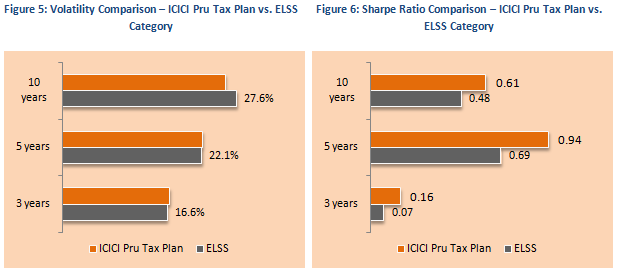
From a risk perspective, the volatility of the fund is in line with the ELSS category. The annualized standard deviations of monthly returns of ICICI Prudential Tax Plan for three to ten year periods are in the range of 17% and 28% respectively, which is slightly on the higher side relative to some of its peers. However on a risk adjusted return basis, as measured by Sharpe Ratio, the fund has outperformed the ELSS category. See charts below for comparison of volatilities and Sharpe ratios between ICICI Prudential Tax Plan and ELSS funds category
Comparison with Peer Set
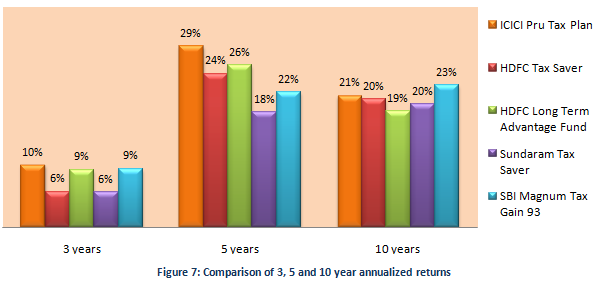
A comparison of annualized returns of ICICI Prudential Tax Plan versus its peer set over various time periods shows why this fund is considered a chart topper. The fund has beaten all its peers in the three and five year time periods, and is second only to SBI Magnum Tax Gain 93 scheme by only a small margin over a 10 year period. See chart below for comparison of annualized returns over three, five year and 10 year periods. NAVs as on Mar 16 2014.
Dividend Payout Track Record
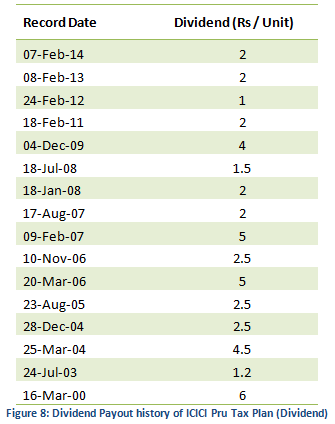
ICICI Prudential Tax Plan Dividend Option has an excellent dividend payout track record. In its nearly 15 year history, the fund has paid dividends every year, except 2001 – 02 and 2010. The fund has paid dividends even during the market downturns in 2008 and 2011. This demonstrates the good track record of the fund even under difficult market conditions.
SIP and Lump Sum Returns
The chart below shows returns as on Mar 16 2014 (NAV of 178.1) of Rs 5000 monthly SIP in the ICICI Prudential Tax Plan Growth Option, for respective years since inception (in August 1999). The SIP date has been assumed to first working day of the month. The amounts are shown in Rs lakhs.
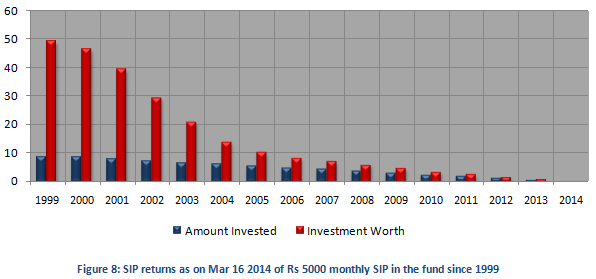
The chart above shows that, a monthly SIP of Rs 5000 from the first working day of the month since inception would have grown to nearly Rs 50 lakhs, while the investor would have invested in total only about Rs 8.6 lakhs. This would imply an internal rate of return of more than 19%, which is much higher than returns of some other tax saving investments (e.g. PPF) in the same period. If the investor started his SIP ten years back, his or her corpus would have grown to nearly Rs 14 lakhs, with an investment of only Rs 6 lakhs.
If the investor had invested Rs 1 lakh in the NFO, his or her investment would have now grown to Rs 17.8 lakhs.
Conclusion
The ICICI Prudential Tax Plan has delivered nearly over 15 years of strong and consistent performance. The fund has established itself as a top performer tax saving scheme with great track record of investment returns and dividends. It is a top pick for investor's tax saving portfolios. ICICI Prudential AMC is one the largest AMCs in the country and funds from the ICICI Prudential stable are among top performers across several mutual fund categories. Investors planning for tax saving investments can consider buying the scheme through the systematic investment plan (SIP) or lump sum route with a long time horizon, for long term financial objectives. The fund has an excellent dividend payout track record, and as such may appeal to investors who prefer dividends. Since the fund manager is relatively new, investors should monitor the performance of the fund to see if the fund manager can continue to deliver good returns. Investors should also ensure that the objectives of the fund are aligned with their individual risk profiles and time horizons. They should consult with their financial advisors if ICICI Prudential Tax Plan fund is suitable for their investment portfolio.
Top 10 Tax Saving Mutual Funds to invest in India for 2016
Best 10 ELSS Mutual Funds in india for 2016
1. BNP Paribas Long Term Equity Fund
2. Axis Tax Saver Fund
3. Franklin India TaxShield
4. ICICI Prudential Long Term Equity Fund
5. IDFC Tax Advantage (ELSS) Fund
6. Birla Sun Life Tax Relief 96
7. DSP BlackRock Tax Saver Fund
8. Reliance Tax Saver (ELSS) Fund
9. Religare Tax Plan
10. Birla Sun Life Tax Plan
Invest in Best Performing 2016 Tax Saver Mutual Funds Online
For further information contact Prajna Capital on 94 8300 8300 by leaving a missed call
---------------------------------------------
Leave your comment with mail ID and we will answer them
OR
You can write to us at
PrajnaCapital [at] Gmail [dot] Com
OR
Leave a missed Call on 94 8300 8300
-----------------------------------------------
