
Best Tax Saving Investment options In India for 2016

Invest in Tax Saving Investment Online
 
Tax Planning Strategies article in Advisorkhoj - Best Tax Saving Investment options

Best Tax Saving Investment Options: An Objective Review (Part 1 of 2) - Section 80C of Income Tax Act allows tax payers to claim deductions from their taxable income (upto Rs 1.5 Lakh) by investing in certain instruments. These options can broadly be classified under three categories

  • Expenses like Tuition Fees, Home Loan Principal Payment and Stamp Duty & Registration charges (for home)

  • Fixed Income investments like PF, PPF, NSC, 5 year tax saving bank FD, 5 year Post Office deposit, Senior Citizen Saving Scheme and Infrastructure Bonds

  • Market Linked investments like ELSS, Life Insurance Premiums, ULIP, Pension Fund and National Pension Scheme

In this 2 part series, we will compare and contrast the different 80C Fixed Income and Market Linked Investments, on some important parameters like returns, liquidity, capital safety and taxability of income / returns. You should evaluate which parameter is important to you, based on your risk profile and financial goals, to objectively determine the most suitable tax saving investment for you. Here is a review of the fixed income investment options under section 80C:-

  • Employee contribution to Provident Fund (EPF):

    Your employer deducts your contribution to your PF account from your monthly pay cheque (12% of your basic salary).The annual interest earned on your PF savings is 8.5%. Provident Fund allows very limited liquidity since you cannot access the funds till your retirement. However, under certain special circumstances you can take a loan from your PF account. The interest earned under EPF is tax free. You can make voluntary contributions over and above the EPF (12% of basic salary), and the tax treatment is the same.

  • Public Provident Fund (PPF):

    PPF is one the most popular choices under Section 80C, since this offers decent interest rates, ensures capital safety and better liquidity than a lot of other instruments. PPF interest rate has been fixed at 8.7% for this fiscal year (2013 – 14). Though rates will vary from year to year, the yield has been pegged at 25 basis points above the 10 year Government Bond yield. The tenure of this instrument is 15 years, and is extendable in blocks of 5 years. Withdrawals not exceeding 50% of 4th year balance are permitted after a lock-in period of 7 years. PPF also offers loan facilities. The maximum and investment under PPF is Rs 1 lakh and Rs 500/-.

  • National Savings Certificates (NSC):

    NSC has been a popular investment choice for many years. In the new NSC scheme the interest rates at 8.5% and 8.8%, for the 5 and 10 year maturities respectively. However, the effective returns are lower, since interest earned in NSC is fully taxable, at your income tax slab rate

  • 5 year Tax Saving Bank Fixed Deposit:

    5 year Tax Saving Bank Fixed Deposits are very similar in nature to NSC. Interest rates offered differs from bank to bank. Currently it is in the range of 8 to 9.1%. Maximum allowable investment is Rs 1 lakh in one year. It is important to note that like NSCs, interest earned by FDs is fully taxable, at the applicable slab rate.

  • 5 year Post Office time deposit:

    The 5 year Post Office time deposit, is in many ways similar to the above two instruments. The current annual interest rate for the 5 year time deposit is 8.4%. Minimum investment is Rs 200, and there is no upper limit. The interest is however fully taxable

  • Tax Free Infrastructure Bonds:

    Infrastructure bonds are becoming increasingly popular choices especially for investors in the higher tax bracket. Infrastructure bonds offer attractive yields, especially compared to bank FDs on a tax adjusted basis. Though the coupon or interest rate varies from issuer to issuer, recent issues by HUDCO and NTPC offered coupon rates of 8.4 to 9%. These bonds are of different tenures from 10 – 20 years. There is no lock-in period for this investment.

  • Senior Citizen Saving Scheme (SCSS):

    This is one of best investment schemes for Senior Citizen. The interest rate on this investment is 9.2%. The scheme allows for an investment upto Rs 15 lakhs and the investor receives interest on a quarterly basis. The maturity of the scheme is 5 years, extendable by another 3 years. The SCSS offers liquidity to the seniors, by allowing premature withdrawals (however charges of 1.5% and 1% deductions in interest apply for closure after 1 and 2 years respectively). The interest earned in this scheme is taxable.

Here is summary analysis of the fixed income investments under Section 80C
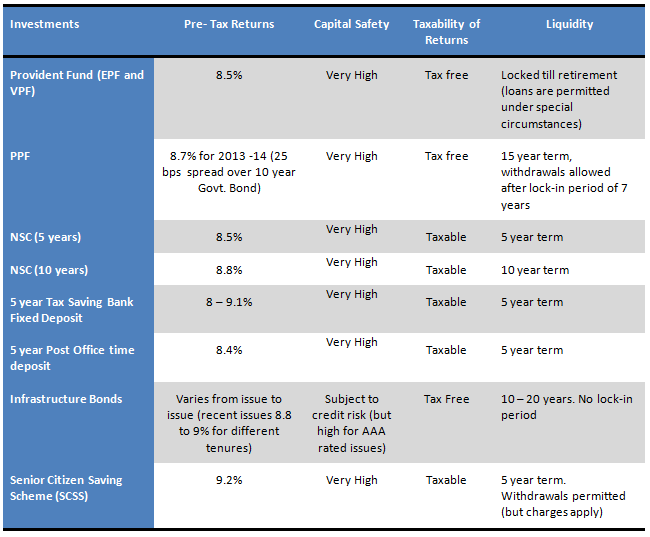
Fixed income investments

Tomorrow will compare and contrast the market linked investment options under Section 80C.

-----------------------------------------------
Invest Rs 1,50,000 and Save Tax under Section 80C. Get Great Returns by Investing in Best Performing ELSS Mutual Funds

Top 10 Tax Saving Mutual Funds to invest in India for 2016

Best 10 ELSS Mutual Funds in india for 2016

1. BNP Paribas Long Term Equity Fund

2. Axis Tax Saver Fund

3. Franklin India TaxShield

4. ICICI Prudential Long Term Equity Fund

5. IDFC Tax Advantage (ELSS) Fund

6. Birla Sun Life Tax Relief 96

7. DSP BlackRock Tax Saver Fund

8. Reliance Tax Saver (ELSS) Fund

9. Religare Tax Plan

10. Birla Sun Life Tax Plan

Invest in Best Performing 2016 Tax Saver Mutual Funds Online

Invest Online

Download Application Forms

For further information contact Prajna Capital on 94 8300 8300 by leaving a missed call

---------------------------------------------

Leave your comment with mail ID and we will answer them

OR

You can write to us at

PrajnaCapital [at] Gmail [dot] Com

OR

Leave a missed Call on 94 8300 8300

-----------------------------------------------

Popular posts from this blog

What are the factors affect the changes in Interest Rate of Fixed Deposits?

  What are the factors affect the changes in rate of Fixed Deposits? Fixed Deposits are now considered to be a very old fashioned method of saving, but still attract many investors since they have guaranteed returns at the end of the tenure of the investment at a decent interest rate. There are various factors that affect the rates of interest for a Fixed Deposit. Policies of the Reserve Bank of India   - The several norms and restrictions posed by the Reserve Bank of India , in order to gain optimum control over credit and inflow and outflow of fund throughout the country. The repo rate changes, cash reserve ration tends to change and these changes affect the banking products like Fixed Deposits, loans etc. Recession   - When unemployment in a country crosses the benchmark set Recession hits, and slowly the country faces an economic slow movement, affecting the purchasing power of the people in the country, forcing the Reserve Bank of India to release more funds in the financial marke...

Capital Protection Oriented Funds

Download Tax Saving Mutual Fund Application Forms Invest In Tax Saving Mutual Funds Online Buy Gold Mutual Funds Leave a missed Call on 94 8300 8300   Capital Protection Oriented Funds   Erosion of capital is one of the key concerns for investors wanting to invest in equity mutual funds. To address this concern, asset management companies have launched Capital Protection Oriented Funds (CPOFs). What are CPOFs? CPOFs are generally three to five-year, closed-ended funds where 70-80% of the portfolio is invested in fixed income securities, which mature on or before the scheme's tenure. The investment in fixed income securities grows to 100% at the end of the tenure, providing the investor with capital protection. The remaining portion (20-30%) is used to take exposure to equity, which provides the upside. Exposure to equities is either by directly buying equity stocks (plain vanilla CPOFs) or by b...

Good Loan

Why Is It A Good Loan?: Loans against gold are cheaper and better than personal loans as the former are available at lower interest rates. In contrast, the interest rates on personal loans are not standardised and can vary from bank to bank. Also, a personal loan depends on a host of factors including, the borrower's salary, profession and the purpose for which the loan is being taken.      For instance, the interest rate on a personal loan of 5 lakh falls in a wide range of 15-30%. But loans against gold are available for as low as 11%. Secured borrowing such as a loan against gold, investments or property is cheaper because it is backed by some assets, which command a good value at any point of time. If the borrower defaults on the loan, the banks can liquidate the assets to settle the loan account.    Being a secured loan, the risk of default and credit losses is significantly lower in this loan compared to other forms of loan for personal use. Given the lower risk, gold loa...

Understanding Your Cibil Credit Information Report

   WE ARE all familiar with the anxiety and uncertainty that we feel when applying for a loan. After all, it's the lender who decides whether we can own our dream home, our first car, or whether our children can pursue higher education. In a nutshell, a better life depends on the lender's decisions.    While other factors do play a part in the lender's decision, the Cibil Credit Information Report ( CIR ) plays a crucial role in a lender's decision to approve a loan application.    Previously, lenders would treat all loan seekers equally. Each applicant, if approved by the lender's internal credit policy, would be charged at the same interest rate for a particular loan size and purpose. The lenders would charge a higher interest rate to all the borrowers, in order to compensate for the possible default of a small portion of the loan disbursed. In other words, it's like a professor (the lender) punishing an entire class (borrowers) for the mischief played b...

Mutual Fund Review: ING Dividend Yield

  ING Dividend Yield's small assets enable the fund manager to churn in impressive returns… Strategy The aim of the fund is to invest in stocks which offer a high dividend yield. This fund deploys a value based strategy which aims to gain from investing in fundamentally strong and free cash flow generating businesses. The scheme focuses not only on growth but also on the cash generated by the business, which mostly leads to stable returns even in volatile markets. This fund has a low volatility because of its investment in high yielding stocks. The scheme tries to include stocks that yield dividend above the dividend yield of the Nifty and stocks with liquidity, which throws up a universe of 150 stocks.   Our View Launched in October 2005, this fund invests at least 65 per cent of its assets in high dividend yield stocks. The fund has consistently maintained a mix of stocks across varying market capitalisation, with a higher tilt to mid caps compared to small caps. Howev...
Related Posts Plugin for WordPress, Blogger...
Invest in Tax Saving Mutual Funds Download Any Applications
Transact Mutual Funds Online Invest Online
Buy Gold Mutual Funds Invest Now