
Equity Market Update - June 2017


Equity Market Update - June 2017

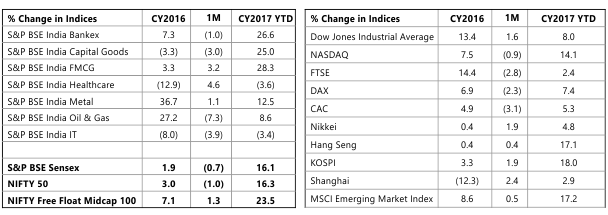
Indian equity markets corrected for the first time in 2017 and were down ~1% in June.

Performance of global equity markets was mixed with Asian indices outperforming the European indices. The table below gives the details of performance of key domestic and global indices.


Performance of key commodities was also mixed during the month, Brent crude being the worst performer down 5%. Lead and zinc were up 8% and 6% respectively.

INR depreciated marginally by 0.1% against USD in June and closed at 64.6, INR has appreciated by 5.2% between December 16' and June 17'.

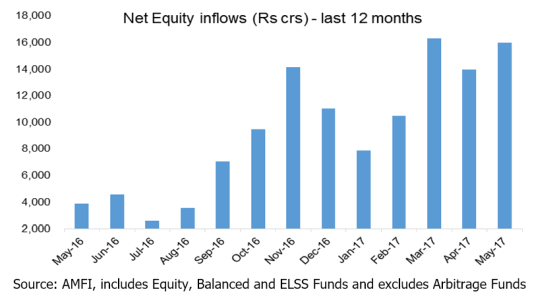
FII's bought Indian equities worth $0.6bn in June. Net inflows in domestic equity oriented mutual funds in May were ~Rs 16,000 crores. The chart below gives the net monthly inflows in equity oriented mutual funds for last 12 months:


During the month few states announced farm loan waiver and 12 large stressed accounts were referred to National Company Law Tribunal (NCLT). May CPI came in at a record low of 2.2% and 4QFY17 CAD came in at 0.6% of GDP.

Equity market have lagged nominal GDP growth for several years now. Profit growth is now improving and earnings growth for next 2-3 years is expected to be strong (Bloomberg consensus NIFTY EPS growth – 16% in FY18 and 22% in FY19). NIFTY 50 is currently trading at ~14.9xFY19E EPS which is reasonable in a low interest rate and strong earnings growth environment. In our opinion therefore, there is merit in increasing allocation to equities (for those with a medium to long term view) and to stay invested.


Invest Rs 1,50,000 and Save Tax up to Rs 46,350 under Section 80C. Get Great Returns by Investing in Best Performing ELSS Funds. Save Tax Get Rich

For further information contact SaveTaxGetRich on 94 8300 8300

OR

You can write to us at

Invest [at] SaveTaxGetRich [dot] Com

OR

Call us on 94 8300 8300


Popular posts from this blog

ICICI Prudential Dynamic Plan Invest Online

Download Tax Saving Mutual Fund Application Forms Invest In Tax Saving Mutual Funds Online Buy Gold Mutual Funds Leave a missed Call on 94 8300 8300   ICICI Prudential Dynamic Plan             Invest Online This fund does remarkably well during falling markets, but fails to show the same prowess during a rising market. The fund sticks to its mandate to adapt to the dynamic nature of the market by shuttling between debt and equity. It takes aggressive asset calls in equity when the market surges by investing in quality mid-cap stocks. At the same time, it adopts a defensive strategy by investing in debt and cash when markets get overvalued, making it a good long-term choice.     For further information contact Prajna Capital on 94 8300 8300 by leaving a missed call     Leave a missed Call on 94 8300 8300   Leave your comment with mail ID and we will ...

Lump Sum or SIP?

Invest Mutual Fund Online     You have a lump sum in hand and you wish to invest in equity funds. However, you have heard a lot of talk about investing in equity funds through Systematic Investment Plans (SIPs) because they help average costs, ensure you do not ill-time the market, and help you invest in small sums, besides giving you many other advantages. So, should you invest the money you have in hand in one go, or let it remain in your bank account and then do an SIP? There is no harm in investing a lump sum amount. For all you know, compounding, over the long term, could work better with lump sum. However, make sure you fulfill all of these three criteria if you want to invest in one go. Else, SIP is the way to go. #1: You invest for the long term According to past data, ideally, if you have a time frame of 12 years or more, you can consider lump sum investing (provided you satisfy the other two conditions that follow). So, what is the sanctity behind 12 years? Is it because only...

Mutual Fund Review: Reliance Regular Savings Balanced

Reliance Regular Savings Balanced fund has shown great resilience during market crash After a shaky start, this fund has established itself as a strong contender in this space. In the past three years it has ridden the market well by not only delivering during the market run-ups but also displaying resilience during the crash. In 2008, it witnessed the second lowest fall among its category and last year it was amongst the top three performers with a return of 76 per cent (category average: 61%).   The poor underperformance in 2006 can well be credited to the low equity allocation of the fund, which stood at just over 10 per cent for only four months that year. Though the fund has the leeway to go up to 75 per cent in equity, it has never touched that limit. In fact, it has exceeded 70 per cent in just five months in its entire history. During the crash of 2008, the fund managers had no problem going right down to 54 per cent (equity exposure). Fund managers Omprakash Kukian and A...

Stock Market Concepts: Derivatives and taxation

DERIVATIVES refer to an instrument, which derives its value from the value of something else — that is, an underlying asset. In India, the derivatives space has traditionally been the playground for large institutional investors who use it for hedging or for speculative activities. However, with time, we have seen a steep augmentation in the per capita income of an average Indian. Consequently, the appetite for investment in alternative instruments has transcended into the need to explore untested territories, and one of the most lucrative of all the available options, is the derivatives. Taxation Of Derivatives: Let's have a sharp overview of how taxability impacts the dealings in futures and options: Futures: Since, there is no transfer or delivery of the underlying asset in case of futures, the income or loss from it cannot be taxed under the head "capital gains". Therefore, depending upon the fact whether the assessee is a trader or an investor, the head of income...

Index funds / Exchange Traded Funds

Download Tax Saving Mutual Fund Application Forms Invest In Tax Saving Mutual Funds Online Buy Gold Mutual Funds Leave a missed Call on 94 8300 8300 Index funds / Exchange Traded Funds Index funds are those funds which replicate a particular stock market index like Nifty, Nifty Junior, Sensex etc. The fund's composition is a mirror image of the index. As there is no active management involved and the fund is expected to generate what a particular index is generating, the fund management charges are very low in these funds. Though over a long period of time good active management does play its part, but many times it has been seen that due to wrong calls of fund manager mutual fund returns suffer very badly. It is then we repent paying heavy charges for fund management. So, to diversify fund manager risk one may look at index funds too. Exchange traded funds also come under this category. As they can on...
Related Posts Plugin for WordPress, Blogger...
Invest in Tax Saving Mutual Funds Download Any Applications
Transact Mutual Funds Online Invest Online
Buy Gold Mutual Funds Invest Now