Franklin India Opportunities Fund

Top SIP Funds Online 


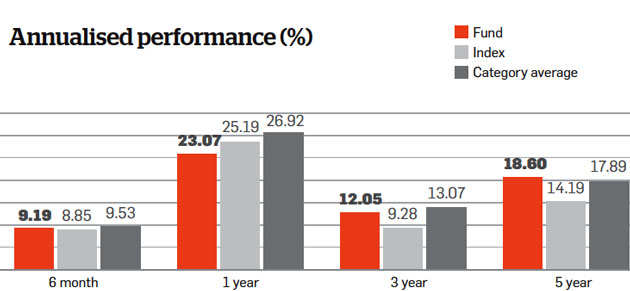
With a 10-year return of 7.6%, the fund has outperformed the benchmark (6.16%) but has significantly underperformed the category (9.28%).The fund's long-term track record is not very healthy. 

Franklin India Opportunities Fund: Patchy long-term record with several years of underperformance

Franklin India Opportunities Fund: Patchy long-term record with several years of underperformance

BASIC FACTS 
Date of launch : 22 Feb 2000 
Category : Equity 
Type : Multi Cap 
Average AUM : Rs 671.29 cr 
Benchmark : S&P BSE 200 Index 

WHAT IT COSTS 
NAVS* 
Growth option : Rs 74 
Dividend option : Rs 21 
Minimum investment : Rs 5,000 
Minimum SIP amount : Rs 500 
Expense ratio (%)^ : 2.74 
Exit load: 1% for redemption within 365 days 

Fund manager : R. Janakiraman 
Tenure: 4 years 6 months 
Education: B.E, PGDM 

Where does the fund invest? 
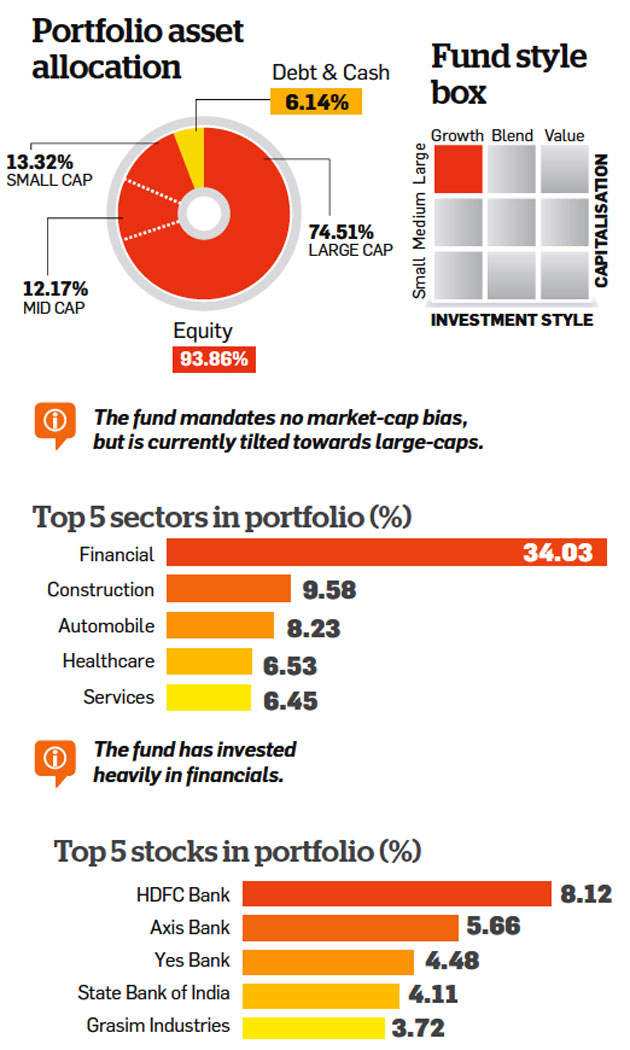
The fund's top picks are mostly from the banking space. 
Franklin India Opportunities Fund: Patchy long-term record with several years of underperformance

How risky is it? 
The fund's risk-reward profile is below average. 
Franklin India Opportunities Fund: Patchy long-term record with several years of underperformance
Franklin India Opportunities Fund takes no particular market-cap bias, but is tilted towards large-caps and follows a broad investment mandate. Its long-term track record is patchy, with several years of underperformance since 2007, relative to peers in the same category. The portfolio is compact with healthy exposure in top bets. The fund manager is comfortable taking large positions in high conviction picks, and also picking stocks from outside the benchmark index. 

However, the portfolio is heavily skewed towards the banking sector, with six of its top 10 stocks from this space. The fund's portfolio turnover has been consistently low in the past few years, indicating a strict buy-and hold approach. Given its weak return profile, other proven flexicap funds from the same fund house are better picks. 


SIPs are when Stock Market is high volatile. Invest in Best Mutual Fund SIPs and get good returns over a period of time. Know Top SIP Funds to Invest Save Tax Get Rich

For further information on Top SIP Mutual Funds contact Save Tax Get Rich on 94 8300 8300

OR

You can write to us at

Invest [at] SaveTaxGetRich [dot] Com 

Popular posts from this blog

All about "Derivatives"

What are derivatives? Derivatives are financial instruments, which as the name suggests, derive their value from another asset — called the underlying. What are the typical underlying assets? Any asset, whose price is dynamic, probably has a derivative contract today. The most popular ones being stocks, indices, precious metals, commodities, agro products, currencies, etc. Why were they invented? In an increasingly dynamic world, prices of virtually all assets keep changing, thereby exposing participants to price risks. Hence, derivatives were invented to negate these price fluctuations. For example, a wheat farmer expects to sell his crop at the current price of Rs 10/kg and make profits of Rs 2/kg. But, by the time his crop is ready, the price of wheat may have gone down to Rs 5/kg, making him sell his crop at a loss of Rs 3/kg. In order to avoid this, he may enter into a forward contract, agreeing to sell wheat at Rs 10/ kg, right at the outset. So, even if the price of wheat falls ...

Mutual Fund MIPs can give better returns than Post Office MIS

Post Office MIS vs  Mutual Fund MIPs   Post office Monthly Income Scheme has for long been a favourite with investors who want regular monthly income from their investments. They offer risk free 8.5% returns and are especially preferred by conservative investors, like retirees who need regular monthly income from their investments. However, top performing mutual fund monthly income plans (MIPs) have beaten Post Office Monthly Income Scheme (MIS), in terms of annualized returns over the last 5 years, by investing a small part of the corpus in equities which can give higher returns than fixed income investments. The value proposition of the mutual fund aggressive MIPs is that, the interest from debt investment is supplemented by an additional boost to equity returns. Please see the chart below for five year annualized returns from Post office MIS and top performing mutual fund MIPs, monthly d...

NRI Corner: The process of remittances abroad

The process of remittances abroad, and back, is cumbersome. Here’s how you can wade through without hassles Approach The Right Place Outward remittances or the process of sending money abroad is governed by many regulations. In India, outward remittances are made mainly through banks. At the outset, you need to remember that you just cannot trust any individual or a financial firm with the responsibility of sending your money. Experts recommend that you should always try to choose a bank with an international footprint, which will make your job easier. Choose Mode Of Transfer The next step is to choose the mode of transfer. One option is to get a Foreign Currency Demand Draft ( FCDD ). This draft will be denominated in foreign currency and should be drawn in favour of the recipient/ beneficiary. The beneficiary does not necessarily need to have an account with the same bank. The other option is to send money via wire transfer. Do not be puzzled if the bank official uses the word SWIFT ...

Zero Coupon Bonds or discount bond or deep discount bond

A ZERO-COUPON bond (also called a discount bond or deep discount bond ) is a bond bought at a price lower than its face value with the face value repaid at the time of maturity.   There is no coupon or interim payments, hence the term zero-coupon bond. Investors earn return from the compounded interest all paid at maturity plus the difference between the discounted price of the bond and its par (or redemption) value. In contrast, an investor who has a regular bond receives income from coupon payments, which are usually made semi-annually. The investor also receives the principal or face value of the investment when the bond matures. Zero-coupon bonds may be long or short-term investments.   Long term zero coupon maturity dates typically start at 10 years. The bonds can be held until maturity or sold on secondary bond markets.

SBI bonds FAQ

  Maximum retail subscription and over – subscription There is a lot of excitement around these bonds, so I won't be surprised if they get over-subscribed on the first day itself. So, I thought Sameer asked a very good question about over-subscription. Here is that discussion. Here are some other questions that you may find useful. Can I trade the SBI bonds on NSE after it lists? Yes, these can be traded after listing. Where can I get the application forms, and can I buy the bonds online? You can get the application from notified branches, and then fill it up there and submit it. To the best of my knowledge, there is no way to invest in them online, but if anyone knows otherwise then please leave a message, and let us know. Can NRIs apply for these bonds? NRIs can't apply for these bonds as they fall under one of the ineligible categories. Can you take a loan by keeping the SBI bonds as security? The terms of the issue in the prospectus state that the bank shall no...
Related Posts Plugin for WordPress, Blogger...
Invest in Tax Saving Mutual Funds Download Any Applications
Transact Mutual Funds Online Invest Online
Buy Gold Mutual Funds Invest Now