
HDFC Prudence Fund

Best SIP Funds to Invest Online 

HDFC Prudence Fund is now HDFC Balanced Advantage Fund

HDFC Prudence Fund (HPF), the country's largest equity-oriented mutual fund scheme with assets close to Rs 37,000 crore, will now be known as HDFC Balanced Advantage Fund and can switch entirely between equities and debt. Until now, it could invest only 40-75% in equities. On 25 April, HDFC Asset Management Co. Ltd announced plans for many of its schemes, as part of the ongoing merger and re-categorisation exercise.

Most other fund houses, too, have announced their plans to re-categorise their schemes. If you don't agree with your schemes' new form, you have a chance to exit without paying an exit load.


Here's how you should decide what to do.
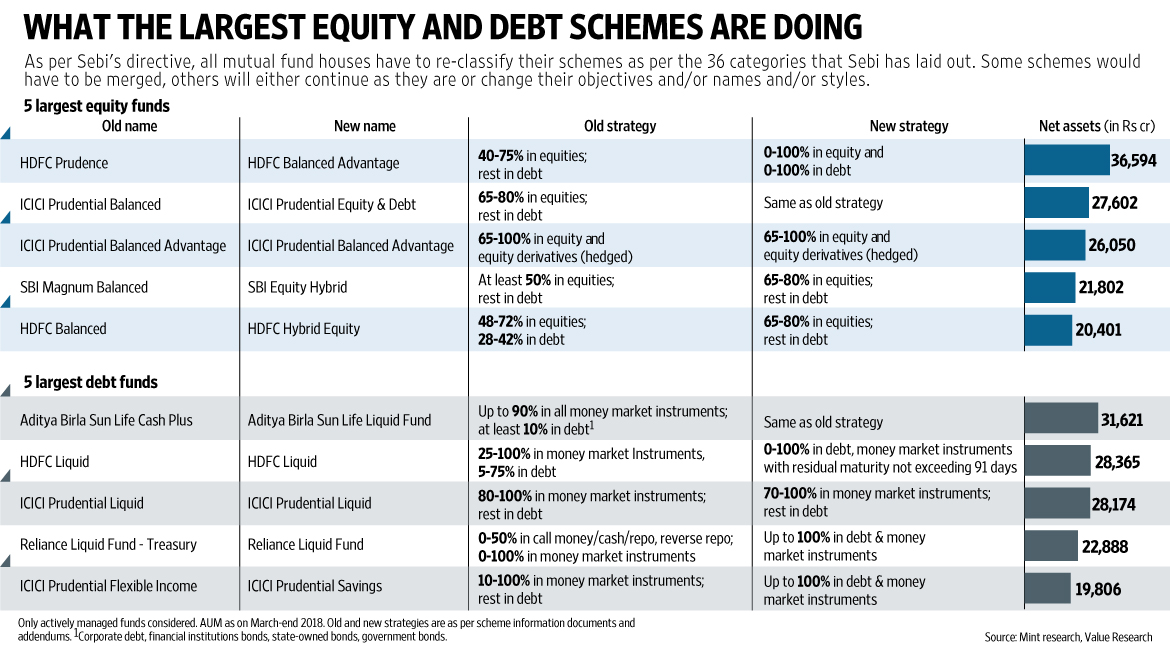

Your scheme could change...

If there is no change to your scheme, you have nothing to worry about. But if your scheme is about to change, check how big or small it is. For instance, if you own a large-cap fund that is set to become a large- and mid-cap fund or a multi-cap fund, it won't matter much. In fact, this particular move is good. Going ahead, it will get difficult for large-cap funds to outperform their benchmark indices. The definition of large-cap fund has narrowed down and benchmarking performances against total returns index would make things tougher for large-cap funds

If your scheme undergoes a big change, evaluate. For instance, SBI Treasury Advantage Fund, which will be known as SBI Banking and PSU Fund, was meant for short-term investments. Now, its strategy would be to invest in debt scrips of state-owned companies and banks. If the risk profile of a scheme changes, look at it again. If it no longer meets your purpose, leave it

...but do not jump the gun

Don't blindly go by the change in your fund category. Mirae Asset Emerging Bluechip Fund (MEBF)—an erstwhile mid-cap fund—has become a large- and mid-cap fund. The name remains the same, and, what's more, the fund remains the same too.

On the face of it, a shift from a mid-cap to a large- and mid-cap fund is a big change. But dig a little deeper and you might not want to worry about it. According to capital markets regulator Securities and Exchange Board of India (Sebi), a large- and mid-cap fund must invest a minimum of 35% each in large- and mid-cap stocks. As it turns out, MEBF has been increasing its exposure to large-cap companies over time; from an average of 20% in 2014 and 26% in 2015 to 38% so far this year, as per Value Research.

We didn't want to tamper our existing portfolios too much. So, whichever categories our funds fitted into naturally, we have moved our funds there. Although a dynamic category fund can switch entirely between equity and debt, a person close to HPF said it can—and will—continue to invest 65-70% in equities like always. Of course, how the fund performs in falling markets in the face of its present equity allocation remains to be seen as the fund will now be compared to other dynamic funds. HPF refused to comment.

The tax implications

If your scheme merges with another or ceases to exist, there are no tax implications. If, however, you choose to withdraw, you may have to pay short-term capital gains tax of 15% (plus surcharge and cess) if you had bought the units in the past one year or long-term capital gains tax, otherwise.

The only respite is you don't pay an exit load, if any, even if you withdraw within the exit load period.


What should you do?

Each merger and re-categorisation poses a unique situation. How one investor reacts to a change could be different from another investor's reaction. Sit with your financial adviser to understand the ramifications of your scheme changes. But here are some broad principles you should follow.

* If your scheme's risk profile increases a little, there is no cause for alarm. For instance, a large-cap fund becoming a large- and mid-cap fund is acceptable. If your scheme's risk profile increases a lot, take a closer look. For instance, SBI Magnum Equity Fund (a large-cap fund) is now a thematic fund SBI Magnum Equity ESG (Environment, Social, and Governance).

* Just because the fund has changed its category or name does not necessarily mean the scheme has changed. Check if the scheme will continue with its strategy.

* But if the scheme's objective has changed—especially due to a merger with some other scheme—evaluate it. HDFC Gilt (government securities) Fund – short-term plan will now be merged with HDFC Corporate Bond Fund. Both schemes are different.

* New investors, beware. Past performance is set to become a bit hazier, especially for those schemes that have to alter their strategies, for the next three years. In this case, check who the fund manager is, and go by his track record.

* Debt funds are trickiest to navigate in this exercise. The good news is that they've become sharper and each of them now comes with a well-defined objective. Revamp your entire debt schemes portfolio.


SIPs are Best Investments when Stock Market is high volatile. Invest in Best Mutual Fund SIPs and get good returns over a period of time. Know Top SIP Funds to Invest Save Tax Get Rich - Best ELSS Funds

For more information on Top SIP Mutual Funds contact Save Tax Get Rich on 94 8300 8300

OR

You can write to us at

Invest [at] SaveTaxGetRich [dot] Com

Popular posts from this blog

Understanding Your Cibil Credit Information Report

   WE ARE all familiar with the anxiety and uncertainty that we feel when applying for a loan. After all, it's the lender who decides whether we can own our dream home, our first car, or whether our children can pursue higher education. In a nutshell, a better life depends on the lender's decisions.    While other factors do play a part in the lender's decision, the Cibil Credit Information Report ( CIR ) plays a crucial role in a lender's decision to approve a loan application.    Previously, lenders would treat all loan seekers equally. Each applicant, if approved by the lender's internal credit policy, would be charged at the same interest rate for a particular loan size and purpose. The lenders would charge a higher interest rate to all the borrowers, in order to compensate for the possible default of a small portion of the loan disbursed. In other words, it's like a professor (the lender) punishing an entire class (borrowers) for the mischief played b...

Myths about Exchange Traded Funds (ETFs)

1) ETFs Are Similar to Individual Stocks: Like MFs, ETF consist of an underlying portfolio of securities that's designed to follow a specific index or investment strategy. Hence, they are as diversified as various mutual funds. 2) ETFs Only Invest in Equity: Since they are listed on the exchange, the general belief is that ETF only consists of equity asset class. Globally, ETFs are available across asset classes – equity, debt, commodities, real estate and so on. In fact, over the past couple of years, India has also seen the emergence of Gold ETFs. 3) All ETFs Are Index Funds: ETF started as a fund which used to track indices and hence they were branded as index funds that are listed. However, ETFs have progressed rapidly and are no longer associated only with passive index funds. Globally, we have seen the launch of actively-managed ETFs. In India, also we recently saw the emer gence of fundamentally-weighted ETFs on Nifty, which busts the myth that ETFs are index funds and can...

What are the factors affect the changes in Interest Rate of Fixed Deposits?

  What are the factors affect the changes in rate of Fixed Deposits? Fixed Deposits are now considered to be a very old fashioned method of saving, but still attract many investors since they have guaranteed returns at the end of the tenure of the investment at a decent interest rate. There are various factors that affect the rates of interest for a Fixed Deposit. Policies of the Reserve Bank of India   - The several norms and restrictions posed by the Reserve Bank of India , in order to gain optimum control over credit and inflow and outflow of fund throughout the country. The repo rate changes, cash reserve ration tends to change and these changes affect the banking products like Fixed Deposits, loans etc. Recession   - When unemployment in a country crosses the benchmark set Recession hits, and slowly the country faces an economic slow movement, affecting the purchasing power of the people in the country, forcing the Reserve Bank of India to release more funds in the financial marke...

REC Tax Free Bond Issue

Tax Saving Mutual Funds Online Current open Infra Bond Application form   Download REC Tax Free Bond Application Forms REC (Rural Electrification Corporation) is going to issue tax free bonds and the issue will open on March 6 2012 and will close on the 12th of March 2012 When you buy 80CCF infrastructure bonds, the amount you invest in those bonds get reduced from your taxable income but in these bonds that's not going to be the case. The interest on these bonds will be tax free and they are similar to the other tax free bonds like the HUDCO, NHAI and PFC issues. For the two of you interested in knowing this – these bonds are tax free under Section 10(15)(iv)(h) of the Income Tax Act. Now on to the issue itself and let's start with the high credit rating that the issue has got. The REC tax free bond issue has been given the highest rating by all issuers since the government owns the majority stake (66.8%) in REC, it has been consistently profit making,  this is a se...

Mutual Fund Review: ING Dividend Yield

  ING Dividend Yield's small assets enable the fund manager to churn in impressive returns… Strategy The aim of the fund is to invest in stocks which offer a high dividend yield. This fund deploys a value based strategy which aims to gain from investing in fundamentally strong and free cash flow generating businesses. The scheme focuses not only on growth but also on the cash generated by the business, which mostly leads to stable returns even in volatile markets. This fund has a low volatility because of its investment in high yielding stocks. The scheme tries to include stocks that yield dividend above the dividend yield of the Nifty and stocks with liquidity, which throws up a universe of 150 stocks.   Our View Launched in October 2005, this fund invests at least 65 per cent of its assets in high dividend yield stocks. The fund has consistently maintained a mix of stocks across varying market capitalisation, with a higher tilt to mid caps compared to small caps. Howev...
Related Posts Plugin for WordPress, Blogger...
Invest in Tax Saving Mutual Funds Download Any Applications
Transact Mutual Funds Online Invest Online
Buy Gold Mutual Funds Invest Now